

Ana Miljački on architectural education, architecture’s audiences, and the work of MIT’s Critical Broadcasting Lab
Ana Miljački is a critic, curator, and professor at Massachusetts Institute of Technology School of Architecture + Planning, where she directs the Critical Broadcasting Lab. Her research interests include the role of architects and architecture in Cold War era Eastern Europe and the politics of contemporary architectural production. She co-curated the US Pavilion at the 2014 Venice Architecture Biennale, OfficeUS.
Following her lecture at CCA in the spring of 2020, Ana sat down with Leandra Burnett and Kurt Pelzer, graduate students in the Master of Advanced Architectural Design program in History Theory Experiments, to discuss her work as an educator, the work of the Critical Broadcasting Lab, and the architectural exhibition as a medium.
Kurt Pelzer:
I had read that in your office there is a sign that says, “Utopia is here just for today.” How does the utopian spirit figure into your thinking and your teaching? Is there a belief in the utopian project?
Ana Miljački:
Did Keith put you up to this one?
Leandra Burnett & KP:
No!
AM:
There was a text I sent him which was, in a way, my letter of intent for tomorrow’s talk. In it, I talk about school as a utopia. For me, this is a key thing, and yes, I do have a poster that says “Utopia is here just for today” on my wall at MIT.
My position on utopia has been changing, even over the last three years. I do love the topic. The colloquial understanding of utopia has been somewhat problematic for my students until I start bringing up things like “We the People” as also a utopia. “We want the most perfect union,” is a utopia, a thing that we strive for, an ideal that has the capacity to drive action. So, I think of utopia not as some totalizing project (though I do study historical versions of those) but as a series of political ideals towards which we strive.
For me, I realize those have a lot to do with some of the models and narratives that I grew up with about equality and justice, but that are somehow harder to entertain in the US context. Until now, that is. I think, I hope, that they’re now back in focus again. So, I believe that in schools, one of our jobs, the key job, is to cultivate utopia and certain kinds of behavior and action that are in line with ideals that we share collectively.
Just two or three years ago, I thought of utopia in the way that Jonathan Letham described it in a challenge he posed to a new president of Bennington College (which is his and my alma mater). He challenged the president to think about utopia at that school as something more than a “pocket utopia”—not just a beautiful place you go to dream up futures. He wanted us to imagine school as a sustained utopia. In Lethem’s definition, utopia is a whisper of a possibility for something other than the status quo, and that (to me) seemed good enough for a while in art and architecture contexts. But I now think that our contemporary political moment requires more. We find ourselves in a place where taking a position is absolutely urgent. And it now seems to me that there just is not enough guarantee in that “whisper of possibility”—which we arrive at by practicing our practices, through improvising, or by stumbling into it—that we will change the status quo. And we must change it.
KP:
How does the idea of taking a position connect with both the broadness of architecture education and the push for individual students to designate a specific “track” to differentiate their work? How do students balance taking a position and being open to other experiences?
AM:
I do think we are in a historic and political moment that requires its own sort of tools and positioning, but it is important to recognize that different temporalities course through architecture school right now, and probably always have. Some of those are temporalities of student life, temporalities of news that surround us, temporalities of practicing architecture, or of producing a body of work in architecture. The discipline isn’t necessarily ready to take on the kinds of things that we find urgent as citizens, but I think pedagogy is. This is, in part, a question of aligning those different temporalities in some way. For me, this is where the Critical Broadcasting Lab at MIT serves as a vehicle by which we can take on urgent questions that we don’t know yet how to land at the center of the discipline.
KP:
You mentioned that, at times, students are more aware of those urgent questions than faculty. As an educator, how do you navigate that?
AM:
Students are demanding that we deal with pressing topics and that we deal with them in a way in which the faculty isn’t always ready to do. Students and faculty are products of different political moments, and our investment and tools to achieve the same goals might not always translate perfectly across generations. For what it’s worth, my reply to students who are demanding studios that are more thoughtful about engagement on the ground is that school needs to be a collaboration. Things won’t really get better if the demands are conceived as requests to the administration to supply something or other—though I hear those demands and we try our best. We need, instead, a true collaboration and to enable forms of co-learning in which the students hold the teachers accountable, and vice versa.
LB:
When do you have that engagement on the ground? The Critical Broadcasting Lab produces architectural publishing, exhibitions, all of these different forms of putting the work out there. How do you identify your audience for this?
AM:
As a pedagogical project, it’s about cultivating the students as an audience. Generationally, the way the production of discourse works is that the most immediate audience is the peer group, and addressing that group is the most important thing. You are cultivating that group as an audience, and you are testing a set of ideas.
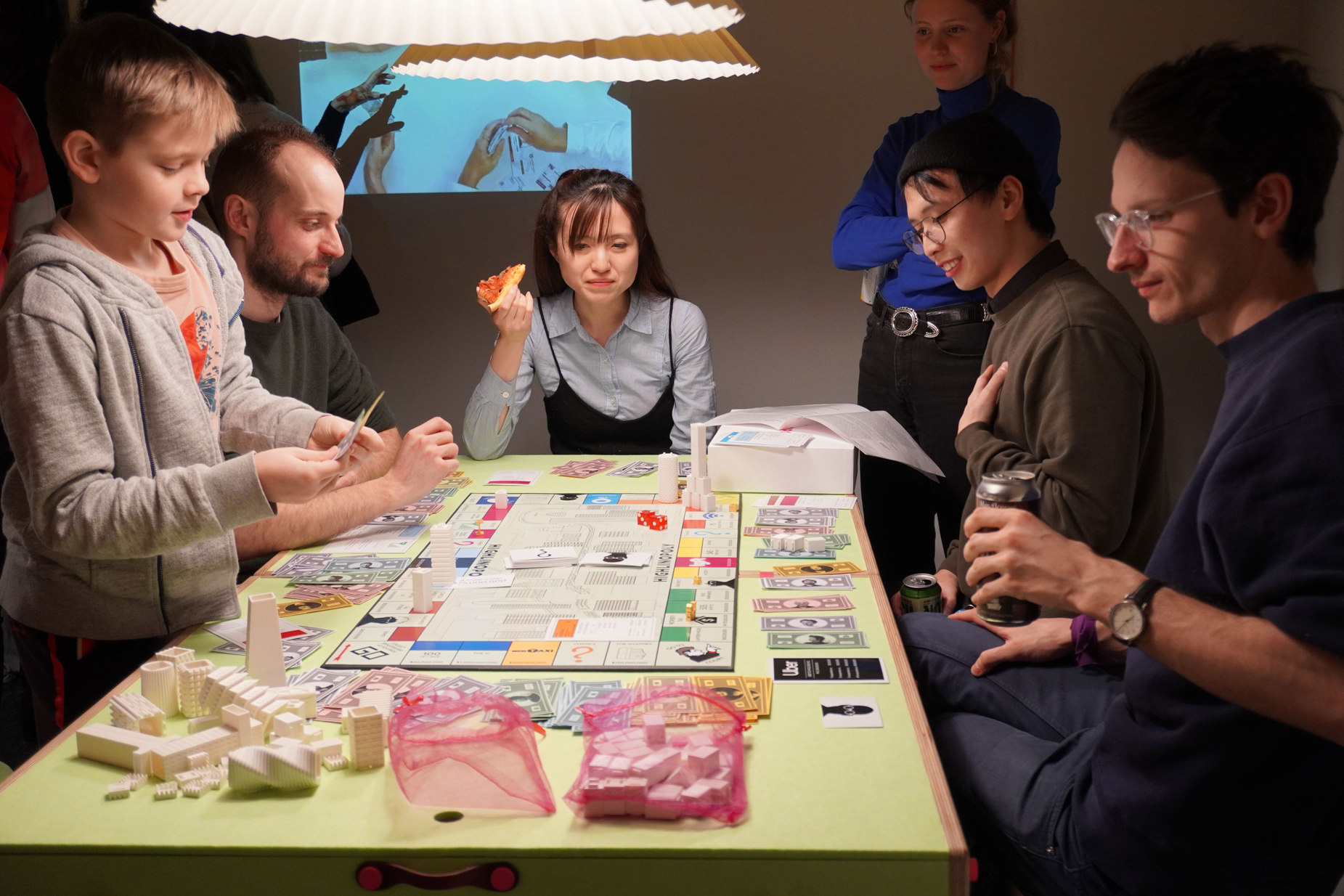
As an example, we are producing a project in the Lab called the Highline-opoly game in which students studied the real estate boom around the Highline in New York and turned the information about property values, news about starchitects, and the urban transformations in the area into a monopoly-type game. You know the kind, your chance card is about the market crashing or someone writing a bad article about it that creates some fallout, etc. They’ve taken these events into the game, and we’re now trying to take it to another level for an audience beyond the school. For now, we’re thinking of it as a limited edition game that we would send to people who we think would want to respond to it.
Audience is an interesting question, though. If you read the mission statement for the Critical Broadcasting Lab, it refers to and problematizes access to a megaphone. I think it’s important for us to be super aware of the kind of communication economy we’re entering into, one in which there are a lot of people with private and institutional megaphones. It matters how one uses those. We are seeking to produce a variety of megaphones for ourselves as the Critical Broadcasting Lab to speak on topics that we think are urgent.
The political philosopher Jodi Dean writes about “communicative capitalism.” She suggests that the key characteristic of our contemporary stage of capitalism, which we already know is circulatory, is that there is a constant flow of statements about politics. Because of the way capitalism integrates itself into that flow, there are distinctions and separations between statements about politics and the ability to act on policy. So, what you find is that many of us, and I’ll include myself here for a moment, feel like we are already activists by producing a set of statements, even though that set of statements has no capacity to be transformative of the reality we live in. But we participate, right? This is very important for me and the Critical Broadcasting Lab because this is a conundrum that isn’t easily solvable, even when you have megaphones—they and their pervasiveness are indeed part of the problem.
LB:
But those statements are cultivating a strength of voice within that culture…
AM:
Yes, that’s the hope, but I think about how this might apply to the exhibition broadcasting complex in architecture. I do think it’s important to have some of these biennials, for example, because they will bring certain questions to the fore, but are they not also places where we speak to ourselves as a discipline and make ourselves feel better about things that we are in fact unable to address? This is a really urgent question to ask in every one of those institutions of circulating messages.
LB:
That’s interesting because when it comes to art biennials, they have been moments where artists have been able to have collective leveraging power, such as the Whitney Biennial in 2019.
AM:
Yes, but the capacity to do that in the art biennial is directly linked to the economic dimension of the art biennial that is very different from the context of an architecture biennial. No architect brings their work to sell it directly, so the withdrawal of work would do very little because nobody would suffer. It is only statements that we bring to the architecture biennial.
LB:
That reminds me of some criticism I saw of this year’s Chicago Architecture Biennial, which was that it didn’t “look like architecture.” There is an expectation that architectural positions be presented in a way that marks them as architecture, but what, then, are the boundaries of the architectural exhibition?
AM:
I think back to the question: what is the contemporary moment? How do we shift the whole terrain? This means we produce things as cultural artifacts that are not necessarily recognized as such by those who have held positions of authority in the field. This is not necessarily familiar, not comfortable, but maybe that’s what’s required. I’m not sure how that actually applies to Chicago, but I think transformation is not always recognizable to those who already have the authority to sanction it as such.
Ana Miljački is an associate professor and the director of the Critical Broadcasting Lab at the Massachusetts Institute of Technology School of Architecture + Planning, where she teaches history, theory, and design.
Kurt Pelzer is a 2020 graduate of CCA’s Master of Advanced Architecture Design program in History Theory Experiments.
Leandra Burnett is a dual degree student in the Master of Advanced Architectural Design and Visual and Critical Studies Programs at CCA.
©2022, California College
of the Arts,
unless otherwise noted
Questions? Contact us at architecture@cca.edu
Identity & Web Design: Manual